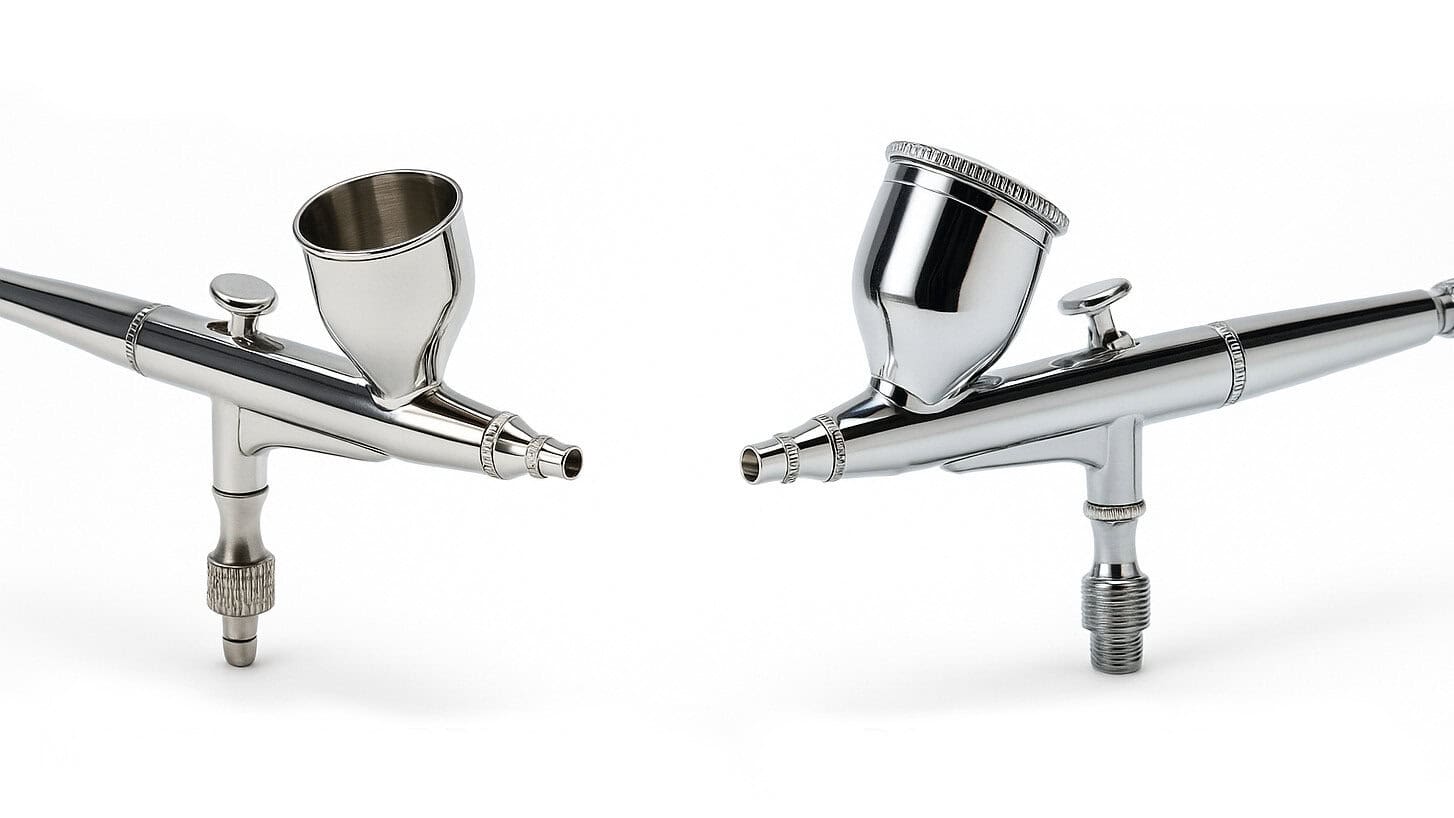
If you’ve ever looked at a makeup airbrush and wondered, “Could I spray paint through that?” — or vice versa — you’re not alone.
This question comes up a lot in airbrush circles, and for good reason. At a glance, both tools look nearly identical. In fact, many airbrushes sold in “makeup kits” are also listed by other retailers as “paint airbrushes.”
So what’s the real difference? Can you use them interchangeably? Or are there hidden issues that could damage your equipment — or worse — cause safety concerns?
I come from the painting side of airbrushing, but this topic has piqued my curiosity for a long time. So I did a deep dive into the specs, setups, and use cases of both makeup and paint airbrush systems. I looked at compressors, needles, fittings, PSI limits, user experiences, and even manufacturer warnings.
What I found surprised me. Because in many cases, these tools are far more alike than they are different — with just a few crucial distinctions that make all the difference depending on your application.
In this guide, I’ll break down those differences, point out the similarities, and show you exactly what’s safe — and what’s not — when crossing over between makeup and paint airbrushing.
Let’s start with the most important factor: pressure.
🎯 What Really Sets Them Apart?
🌬️ Compressor Pressure Limits
The biggest difference isn’t the airbrush itself. It’s the compressor.
Makeup airbrush kits almost always come with low-pressure compressors that cap out at around 15 PSI. This is by design. Spraying directly onto skin with higher pressure could cause irritation, injury, or other health issues. The low PSI keeps application gentle and safe for cosmetic use.
Paint airbrush kits, on the other hand, are built for power. Even entry-level paint compressors typically produce 30 to 60 PSI or more. You need that higher pressure to properly atomize paint, especially if it’s thicker or less refined.
Bottom line:
- Makeup compressors = low PSI (under 15)
- Paint compressors = medium-to-high PSI (30+)
Trying to run paint through a makeup compressor? You’ll likely get spitting, clogging, and poor atomization.
Trying to use makeup with a paint compressor? You risk blasting makeup onto skin at a pressure that could be unsafe.
🪝 Needle Size & Spray Pattern
Needle size is another area where things diverge.
Makeup airbrushes usually have a 0.4mm to 0.5mm needle, which makes sense — they’re used for soft gradients and smooth layering. Bigger needles help push thicker, creamy pigments through at lower pressure.
Paint airbrushes use a wider range of needle sizes, from fine-detail 0.2mm up to 0.5mm for coverage work. While the 0.5mm needle is common in both camps, it’s the use case and flow rate that change the performance.
If you’re planning to spray paint through a makeup airbrush, thinning your paint becomes critical. Otherwise, you’re going to clog it up fast.
🔌 Hose Connectors & Compatibility
This is a subtle, but frustrating difference.
Makeup airbrushes often use barbed hose fittings — the kind you just push tubing onto. It works fine at low pressures but becomes unreliable when PSI increases. That hose can pop off mid-use if you’re pushing 25 PSI or more.
Paint airbrushes typically use threaded or quick-connect fittings, which are designed to handle higher pressures safely and securely.
So if you want to upgrade a makeup airbrush for paint, you might need a new hose or adapter.
🛠️ Disassembly & Cleaning Considerations
One of the biggest risks of using a makeup airbrush for paint is residue buildup.
Paints (especially acrylics or urethanes) can dry hard inside the airbrush if not cleaned properly. If your airbrush doesn’t fully disassemble, or you don’t have access to all internal passages, you might never get it fully clean.
That becomes a huge problem if you ever want to use the airbrush for makeup again. You don’t want microscopic traces of paint or solvent near someone’s skin.
Rule of thumb: If the airbrush can’t be completely cleaned or broken down, don’t cross-contaminate it.
✅ What’s Actually the Same?
✍️ Body Style & Airbrush Design
In many cases, the airbrush included in a “makeup” kit is identical to one sold in a “paint” kit.
I’ve seen the Iwata Revolution marketed both ways. The difference? What compressor it’s paired with and who’s selling it. Gravity-feed, dual-action brushes dominate both categories.
So the airbrush itself isn’t always exclusive to one type of work. It’s the accessories, branding, and intended use that shift.
⚙️ Internal Mechanism & Functionality
The trigger, valve, nozzle, air cap — these components all work the same across the board.
Airbrushes atomize liquid via compressed air, regardless of what that liquid is. Makeup and paint are just different materials being processed through a fundamentally identical system.
That’s why many manufacturers don’t even label airbrushes as “for makeup” or “for paint.” They simply offer different needles, compressors, and hoses for different jobs.
🔄 Using a Makeup Airbrush for Paint (And Vice Versa)
🧴 Makeup → Paint: What You Need to Know
If you’re thinking about using a makeup airbrush for painting:
- Check the needle size: You want at least 0.4mm for thicker paints
- Thin your paint properly: It should flow like milk
- Upgrade your compressor: A 15 PSI unit won’t cut it for most paint applications
- Replace the barbed hose with a threaded or quick-connect fitting for safety
- Clean thoroughly: Make sure you can reach every internal surface
🎨 Paint → Makeup: Risks, Mods, and Safety Notes
Using a paint airbrush for makeup can work — but it requires caution:
- Keep PSI under 15: Use an inline regulator to limit pressure
- Use only cosmetic-safe materials: Never spray solvents or harsh chemicals previously used in the brush
- Thoroughly clean the airbrush: Residual paint or thinners can be dangerous
- Avoid siphon-feed models: Gravity-feed airbrushes are better suited for precision makeup work
- Always use the needle guard: Not using the needle guard will expose the sharp needle, if it makes contact with the skin, it will harm the applicant.
When in doubt, designate one airbrush for makeup only and avoid mixing materials.
🧐 Expert Take: What Matters Most?
Based on all my research, testing, and observations, here’s my takeaway:
The real difference isn’t the airbrush. It’s the compressor.
Needle sizes, hose fittings, and designs may vary slightly, but most airbrushes are cross-compatible when cleaned and configured properly.
However, running a low-pressure makeup compressor for paint will give you headaches. And blasting makeup at 30+ PSI can cause harm.
So use the right compressor for the job. And keep cleaning and safety at the top of your priority list.
📊 Comparison Table: Makeup vs Paint Airbrush Kits
| Feature | Makeup Airbrush Kit | Paint Airbrush Kit |
|---|---|---|
| Compressor PSI Range | Up to 15 PSI (Max) | 30–60+ PSI |
| Typical Needle Size | 0.4–0.5mm | 0.2–0.5mm |
| Hose Fittings | Barbed | Threaded / Quick-Connect |
| Spray Detail | Soft gradients, coverage | Fine lines to full coverage |
| Cleaning Ease | Varies by model | Varies by model |
🔚 Conclusion: What You Should (and Shouldn’t) Mix
So, can you use a makeup airbrush for painting? Yes — if you have the right compressor, the right needle size, and a properly thinned medium.
Can you use a paint airbrush for makeup? Also yes — if you can keep the PSI low, the brush is properly cleaned, and it hasn’t been exposed to solvents or toxic materials.
When in doubt, use equipment as intended. But if you’re a DIYer or curious artist like me, just know that the gear itself is often more flexible than the marketing makes it seem.
Airbrush Insider exists to help you master your tools — no matter what you’re spraying.
This is Colt signing off!