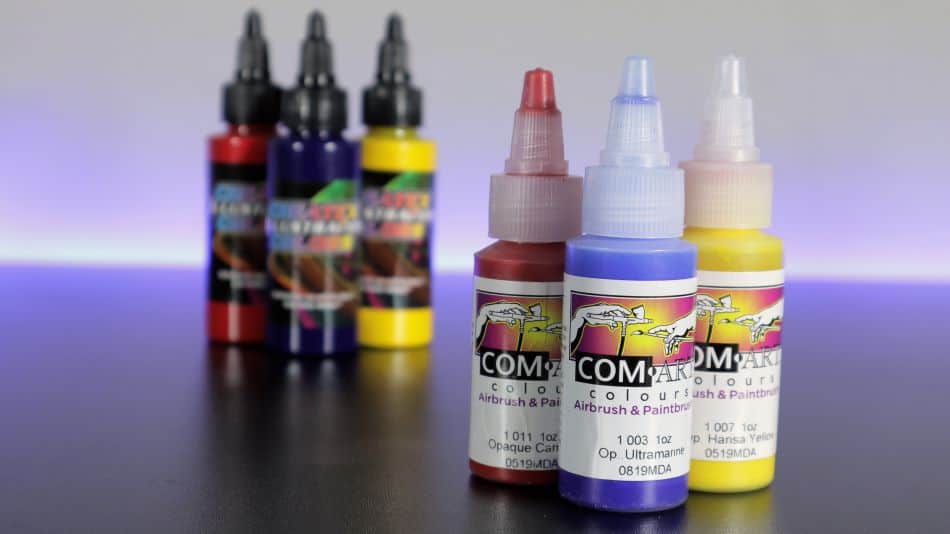
Water-based paints—especially acrylics—are incredibly popular in airbrushing because they’re easy to clean up, dry quickly, and are safer to use indoors. From scale models and canvas artwork to textiles, cosplay props, and even body painting, water-based paint offers versatility across many surfaces and styles.
But here’s the catch: while it’s absolutely possible to airbrush with water-based paint, you can’t just pour it in and go. Because of its fast drying time and higher surface tension, water-based paint requires the right setup, thinning ratio, and spraying technique. If not used properly, it can clog your airbrush, dry on the needle tip, or create patchy, uneven results.
That’s where this guide comes in.
Whether you’re switching over from solvent-based paints or just starting out, this in-depth tutorial will show you exactly how to:
- Choose the best water-based paints for your project
- Mix and thin your paint for smooth, clog-free spraying
- Dial in the right PSI and nozzle size for optimal atomization
- Troubleshoot common problems like spitting or tip dry
- Clean your airbrush the right way after use
By the end, you’ll have the confidence and knowledge to spray water-based paints effectively — and avoid the most common beginner mistakes.
🔹 1. Can You Airbrush with Water-Based Paint?
Yes. Water-based paint can be used in an airbrush system, provided it is properly thinned to the correct consistency, matched with the right air pressure (PSI), and sprayed using an appropriate nozzle size. For best results, use high-flow acrylics or paints specifically formulated for airbrushing, and clean the airbrush frequently to prevent tip dry and clogging.
Why Use Water-Based Paints in the First Place?
There are several reasons airbrush artists—especially beginners and home users—gravitate toward water-based paints:
- Low toxicity and low odor: No harsh fumes or special ventilation needed
- Easy cleanup: Rinse with water instead of using strong solvents
- Faster drying times: Great for layering, but can increase tip dry
- Versatile: Can be used on plastic, paper, canvas, textiles, resin, and more
- Widely available: Found at art stores, hobby shops, and even some hardware stores
That said, not all water-based paints are created equal. Some are ready-to-spray right out of the bottle, while others require thinning and careful setup. In the next sections, we’ll cover the best types of water-based paints to use—and which to avoid.
🔹 2. Best Water-Based Paints for Airbrushing
Not all water-based paints are airbrush-friendly. Some are made specifically for smooth atomization and fine detail work, while others—like heavy-body or craft paints—can clog your airbrush unless heavily thinned and strained.
If you’re new to this, look for high-flow acrylics or paints labeled “airbrush-ready.” These are typically thinner, more finely pigmented, and designed to spray smoothly with minimal clogging or tip dry.
🎯 What to Look for in a Good Water-Based Airbrush Paint:
- ✅ Fine pigment grind – reduces clogging
- ✅ Pre-thinned or high-flow consistency – sprays without heavy dilution
- ✅ Strong surface adhesion – bonds well to plastic, resin, fabric, etc.
- ✅ Low tip-dry tendency – helps with fine detail and long sessions
- ✅ Compatibility with reducers – essential for dialing in viscosity
- ✅ Color reliability – especially important for models and fine artwork
🔹 3. Best Thinners and Additives for Water-Based Airbrush Paint
When using water-based paint in an airbrush, thinning it correctly is crucial — and plain water isn’t always the best solution.
While many beginners assume you can just add tap water, doing so can lead to poor atomization, fuzzy edges, or tip dry. That’s where dedicated thinners and flow additives come in — they help reduce surface tension, improve flow, and keep your needle from drying out mid-spray.
🎯 What to Use (and Why):
- ✅ Brand-specific airbrush reducers
Designed to perfectly match the chemistry of their paints (e.g. Vallejo Thinner, Createx 4011 Reducer). They maintain binder strength while lowering viscosity. - ✅ Flow improvers / flow aids
Slow drying at the needle tip and reduce skipping during detail work. A few drops go a long way. - ✅ Distilled water
Okay in small amounts, especially when paired with a flow aid. Avoid tap water — minerals can react with the paint or leave deposits. - ✅ Homemade blends (with caution)
Some artists use DIY mixes (e.g. 90% distilled water + 10% isopropyl + drop of glycerin). These can work — but they’re not foolproof.
⚠️ What to Avoid:
- ❌ Tap water (can introduce impurities or minerals)
- ❌ Gel mediums or brush-only acrylic mediums (too thick for airbrush use)
- ❌ Too much flow improver (can affect adhesion and drying time)
📊 Quick Comparison: Thinners & Additives
| Additive Type | What It Does | When to Use |
|---|---|---|
| Airbrush Thinner | Lowers viscosity safely | Always — for smoother atomization |
| Flow Improver | Delays drying on needle tip | For fine lines or slow passes |
| Distilled Water | Budget-friendly thinning base | In a pinch, or with flow aid |
| DIY Mixes | Custom blend for control | Advanced users only |
🧠 Quick Tip:
Always test your mix before pouring it into your main airbrush. A paint that flows perfectly one day might behave differently depending on weather, humidity, or batch.
🔹 4. How to Thin Water-Based Paint for Airbrush Use
Thinning water-based paint correctly is one of the most important steps to getting smooth, clog-free results with your airbrush. Even the best paints won’t perform well if they’re too thick for your nozzle or PSI setting.
So how thin should your paint be?
The goal is to reach a viscosity similar to skim milk — thin enough to atomize easily, but thick enough to carry pigment without spitting or spidering.
🧪 Basic Mixing Guidelines:
- Start with a 3:1 paint-to-thinner ratio
That means 3 parts paint, 1 part thinner or reducer. Adjust slightly based on how thick the paint is to start.- Adjust based on nozzle size and PSI
Smaller nozzles (0.2–0.3mm) usually need thinner mixes than larger ones (0.4–0.5mm+)- Test on a paper towel or test surface before committing
A good spray should feel misty and even — not spattery, gummy, or watery.
🔍 Quick Visual Test:
Stir the paint and lift your stir stick:
If it drips off smoothly with no blobs or strands, you’re close.
If it runs like water, it’s too thin. If it clings like cream, it’s too thick.
⚠️ Tip: Always Mix in a Separate Cup
Don’t mix directly in your airbrush cup. It’s harder to control ratios and can trap unmixed chunks that clog your nozzle. Use a small mixing cup or palette, stir well, and strain if needed.
🔹 5. Best PSI and Nozzle Size for Water-Based Airbrush Paint
Once your paint is thinned correctly, your air pressure (PSI) and nozzle size become the two most important settings in your airbrush setup — and they work together.
Think of it like this:
🎯 Your nozzle controls how much paint can flow.
💨 Your PSI controls how forcefully that paint is sprayed.Water-based paints tend to be thicker than solvent-based options and dry faster once atomized. That means they:
- Need slightly more PSI to atomize evenly
- Are less forgiving of mismatched setups (e.g., high PSI + small nozzle = overspray or spidering)
- Can clog easily if the nozzle is too fine or the pressure too low
That’s why matching the right nozzle size with the right PSI is critical to avoid problems like:
- Splattering
- Dry tip
- Inconsistent spray patterns
- Uneven coverage or spidering on the surface
🎯 General PSI & Nozzle Guidelines
Application Type PSI Range Nozzle Size Notes Fine Detail Work 18–25 PSI 0.2–0.3 mm Use well-thinned paint + flow improver General Coverage / Art 25–35 PSI 0.3–0.5 mm Works for most t-shirts, illustrations Large Surface Spray 30–40+ PSI 0.5+ mm Only with well-thinned paints (e.g. walls, props)
🧠 Quick Tips:
- If your airbrush sputters, increase PSI slightly or thin the paint more
- If you see spidering, lower PSI or spray from farther away
- Smaller nozzles require more precise thinning — start with 3:1 and adjust
- Use a compressor with a regulator and moisture trap for consistent pressure
⚠️ Warning:
Don’t crank up the PSI just to “force” thicker paint through. You’ll get splatter, rough edges, and rapid tip dry. If it won’t spray at 30 PSI or below, your paint’s likely too thick or not mixed well.
🔹 6. Solutions to Common Water-Based Airbrush Problems (Clogging, Tip Dry, Sputtering & More)
Using water-based paints in your airbrush has major upsides — low odor, easy cleanup, and a wide variety of artistic options. But they also tend to be less forgiving when it comes to clogs, tip dry, and inconsistent spray behavior.
This section will walk you through:
- How to prevent clogs and tip dry before they start
- What to do when your spray sputters or your airbrush won’t spray at all
- How to quickly diagnose and fix the most common water-based airbrush issues
✅ How to Prevent Clogs and Tip Dry Before They Start
1. Thin your paint properly
Even “airbrush-ready” paint often needs a touch of reducer. Use a 3:1 ratio (paint:thinner) as a starting point. Aim for a skim milk consistency.2. Add a flow improver
This helps prevent paint from drying on the needle tip (aka “tip dry”). Just a few drops make a big difference.3. Clean the needle tip while spraying
Stop every few minutes and gently wipe the needle with a damp cotton swab. It only takes a second, but prevents most dry-tip issues.4. Use the correct PSI for your nozzle size and paint mix
Low PSI and thick paint are a clogging disaster. (See Section 5 for detailed pressure ranges.)5. Strain your paint
This removes clumps or dried bits that can instantly clog your nozzle. Use a mesh strainer or fine stocking.6. Don’t let paint sit in your airbrush
Even a short break can cause water-based paint to dry inside. Always flush with water or cleaner before stepping away.7. Perform a mid-session flush
After spraying for a while, do a quick rinse with cleaner or water to flush out paint that may be starting to dry inside the nozzle.
🔍 Problem → Fix Breakdown (Quick Diagnosis Guide)
🎯 Problem: Spitting or Sputtering Spray
Why it happens:
Paint is too thick, PSI is too low, or there’s partial clogging.Fix it by:
- Thinning paint slightly more
- Increasing PSI by 5–10 PSI
- Cleaning your nozzle and needle
🎯 Problem: Spidering or Paint Runs
Why it happens:
Too much paint in one spot — either from over-thinning, high PSI, or spraying too close.Fix it by:
- Reducing PSI
- Holding the airbrush farther from the surface
- Letting each layer flash dry before reapplying
🎯 Problem: Tip Dry
Why it happens:
Water-based paint dries quickly on the needle tip during spraying.Fix it by:
- Adding flow improver
- Wiping the needle with a swab periodically
- Avoiding direct heat (like lamps or sunlight)
🎯 Problem: Bubbling in the Paint Cup
Why it happens:
Air is leaking back into the paint path — usually due to poor nozzle seating or dried paint in the nozzle threads.Fix it by:
- Re-seating the nozzle
- Cleaning threads and nozzle cap
- Ensuring everything is properly tightened
🎯 Problem: Nothing Sprays at All
Why it happens:
The nozzle is fully clogged or the paint has dried inside.Fix it by:
- Doing a full teardown and soak
- Using a nozzle cleaning wire
- Straining paint before future use
🔹 8. How to Clean an Airbrush After Using Water-Based Paint
Water-based paints are easier to clean than solvent-based options — but they dry fast, and once dry, they can still be a pain to remove from tight nozzle spaces. That’s why timely, proper cleaning is essential to avoid clogs and keep your airbrush performing smoothly.
Even if you’re just pausing for lunch or wrapping up a short session, flushing and cleaning your airbrush right after spraying is non-negotiable.
🧼 Basic End-of-Session Cleaning Routine
1. Flush the cup with water or cleaner
Spray clean water or a water-based airbrush cleaner through the brush until it sprays clear.2. Backflush to loosen internal residue
Cover the nozzle with a paper towel and gently press the trigger. You’ll see bubbling in the cup — this pushes cleaner back through the nozzle. Do this 2–3 times.3. Remove the needle and wipe it down
Pull the needle out carefully and wipe off any paint or dry residue with a soft cloth or damp paper towel.4. Wipe the cup and nozzle
Use a cotton swab or small brush to clean any leftover paint in the cup, nozzle area, or air cap.5. Reassemble and store
Put everything back together loosely — especially the needle cap — so parts don’t stick together as they dry.
⚠️ What Happens If You Skip This?
Even if water-based paint seems harmless, it dries stubbornly once it’s in your nozzle or trigger area. Skipping a simple end-of-day rinse can lead to:
- Total blockages next time you spray
- Dried flakes breaking loose mid-project
- Trigger or air valves sticking
🔹 9. FAQs: Water-Based Paint and Airbrushing
Here are the most frequently asked questions about using water-based paints in an airbrush — whether you’re just starting out or switching from solvent-based systems.
❓Can you use water as a thinner for airbrushing?
Yes, but it’s not ideal. While water can reduce paint viscosity, it doesn’t contain the additives found in proper airbrush reducers — like surfactants, binders, or flow agents. This means:
- More tip dry
- Reduced flow consistency
- Weaker paint adhesion
➡️ For smoother spraying, especially at lower PSI or with fine detail work, it’s best to use a brand-specific reducer or flow improver.
❓Do water-based paints damage airbrushes?
No — in fact, they’re safer than solvent-based options.
Water-based paints are non-corrosive and generally easier on airbrush components. However, they dry very quickly, which can cause buildup in the nozzle or trigger mechanism if not cleaned promptly after use.➡️ As long as you flush your airbrush after each session, you won’t run into problems.
❓Can you mix different brands of water-based airbrush paint?
You can, but it’s risky. Different brands often use unique formulas — especially when it comes to pigments, binders, and resin types. Mixing across brands may result in:
- Clumping or gelling
- Uneven flow
- Unexpected drying behavior
➡️ If you need to mix, test in a small batch first. For best results, stick to one brand per project.
❓Is water-based airbrush paint good for automotive, fabric, or models?
Yes — if you choose the right type for the surface.
Water-based paints are highly versatile, but they’re not one-size-fits-all. Here’s a quick guide:
Application Recommended Paint Type Automotive Createx Auto Air, House of Kolor Aqua Fabric Createx Textile, Wicked Colors, or fabric acrylics Plastic Models Vallejo, Tamiya, AK Interactive ➡️ Always use a compatible primer and seal your work with a clear coat where needed.
❓Can I leave water-based paint in my airbrush overnight?
No — never.
Water-based paint dries fast, and once dry, it becomes extremely difficult to remove from tight nozzle passages and the trigger assembly. Leaving it overnight can:
- Clog your nozzle
- Gum up internal valves
- Require a full teardown to fix
➡️ Always flush your airbrush after use, even during short breaks.
❓Do I need a primer when using water-based paint?
Yes — especially on slick surfaces.
Water-based paint doesn’t naturally grip smooth materials like metal, plastic, or resin. Without a primer, it can bead, peel, or flake off.➡️ Use a surface-appropriate primer like:
- Acrylic gesso for canvas or wood
- Automotive adhesion promoters for plastics or helmets
- Miniature hobby primers for resin and styrene kits
❓Are water-based paints safe to airbrush indoors?
Yes — but good ventilation still matters.
Water-based paints are low-odor and non-toxic compared to solvents, but you’re still atomizing pigment particles into the air.➡️ For safe indoor use:
- Spray in a well-ventilated area
- Use a spray booth with an exhaust fan if possible
- Wear a respirator when spraying for long sessions