Airbrushing is both an art and a craft—and choosing the right airbrush is the foundation of your results. If you’ve been exploring airbrush options, you’ve no doubt heard the term gravity feed airbrush. But what is it exactly, and why do so many professionals swear by it?
In this comprehensive guide, we’ll unpack everything you need to know about gravity feed airbrushes: how they work, their advantages and limitations, how they compare to other types like siphon and side feed, and how to choose the best one for your work.
Let’s get into it.
⏩ Want to skip straight to the best models? Jump to Top Recommended Gravity Feed Airbrushes
🧰 What Is a Gravity Feed Airbrush?
A gravity feed airbrush is a type of airbrush where the paint cup is located on top of the body. Instead of relying on suction or pressure to pull paint into the nozzle, gravity does the work—letting paint naturally flow down into the mixing chamber as you spray.
This design allows for:
- Lower working air pressure
- Finer control
- Less paint waste
They are a go-to tool for model painters, illustrators, nail artists, cake decorators, and custom automotive artists who need precision and subtle gradients.
⚙️ How a Gravity Feed Airbrush Works
The design is simple, but effective.
✅ Key Components:
- Top-mounted paint cup (usually 1ml to 7ml)
- Dual-action trigger (controls both air and paint)
- Needle and nozzle (determines spray pattern)
- Compressor or air source (often 10–25 PSI is sufficient)
When you press the trigger, air flows through the airbrush. As you pull back, the needle retracts, allowing paint to mix with air and exit the nozzle. Because paint is delivered by gravity, less air pressure is needed to atomize it compared to siphon-fed alternatives.
✅ Benefits of Using a Gravity Feed Airbrush
Let’s explore why gravity feed airbrushes are so popular—especially among detail-focused artists.
🌟 1. Better Fine-Line Control
Lower pressure + direct paint flow = exceptional precision. Gravity feed is ideal for ultra-fine detail, whether you’re doing highlights on a Warhammer miniature or fine pinstriping.
🌟 2. Reduced Overspray
Lower pressure means less atomization drift—making it easier to spray exactly where you want without masking everything around it.
🌟 3. Less Paint Waste
Because the paint flows downward naturally, you don’t need to fill the cup with much paint. Every drop counts, especially with premium paints or mixed custom tones.
🌟 4. Easier to Clean
Smaller paint cups mean less internal surface area. This also makes it quicker to change colors between passes.
🌟 5. Great for Beginners
With fewer components and easier troubleshooting, gravity feed airbrushes are beginner-friendly and less intimidating than bottom-fed setups.
⚠️ Drawbacks You Should Know
Gravity feed airbrushes are powerful tools—but they’re not without their downsides.
⛔ Smaller Cup Capacity
Most gravity feed cups hold between 1–3ml. That’s perfect for detail work, but a pain for large surfaces like murals or T-shirt backgrounds.
⛔ Cup Obstructs View Slightly
Since the paint cup sits on top, it can partially block your line of sight—especially with larger cups.
⛔ Frequent Refilling
If you’re doing large color fields or repetitive patterns, expect to refill often.
⛔ Less Ideal for Heavy Viscosity Paints
Gravity feed works best with thinned paints. Thicker paints may need more air pressure or a larger nozzle size.
🎨 Best Uses for Gravity Feed Airbrushes
Not sure if gravity feed is the right choice for your project? Here’s where it shines:
| Use Case | Gravity Feed Advantage |
|---|---|
| Miniature Painting | Precise control, subtle shading |
| Fine Art Illustration | Gradient transitions, low overspray |
| Nail Art & Body Art | Clean detail at low pressure |
| Cake Decoration | Food-safe applications with tiny color changes |
| Automotive | Controlled spray on panels, graphics, pinstriping |
| Airbrush Makeup | Gentle mist at low PSI, less product waste |
If your work emphasizes control over coverage, gravity feed is your ally.
⚖️ How to Choose the Right Feed Type for Your Projects
Choosing the right airbrush feed type depends on how you work, what you’re painting, and how much detail your projects require. Here are the three key considerations:
- Project Size: Are you covering large areas or working on tiny models? Larger surfaces benefit from siphon or side feed; detail-focused tasks favor gravity feed.
- Detail Level: The finer the work, the more important consistent flow and low overspray become. Gravity feed airbrushes are top-tier here.
- Workflow Efficiency: Do you switch colors often? Need large paint reservoirs? Consider how each feed type supports your pace, paint usage, and cleanup time.
Let’s break down how gravity feed compares to the other two popular types:
Gravity Feed vs Siphon Feed Airbrush
| Feature | Gravity Feed | Siphon Feed |
| Paint Cup Location | On top | Beneath the airbrush |
| Paint Flow Method | Gravity-assisted | Suction-assisted |
| Air Pressure Needed | Lower (10–25 PSI) | Higher (20–40 PSI) |
| Paint Capacity | Small (1–7 ml) | Large (20+ ml bottles) |
| Detail Work | Excellent | Moderate |
| Overspray | Low | Higher potential |
| Paint Waste | Minimal | More likely |
| Cleaning Time | Fast | More parts, longer |
| Ideal For | Detail work, small-scale art | Large coverage: murals, T-shirts, base coats |
Verdict:
Choose gravity feed for fine detail and efficiency. Go with siphon feed if you’re blasting color over large surfaces repeatedly.
Gravity Feed vs Side Feed Airbrush
| Feature | Gravity Feed | Side Feed |
| Paint Cup Location | Top-mounted | Side-mounted (left/right) |
| Visibility While Spraying | Slightly obstructed by cup | Unobstructed view |
| Cup Flexibility | Fixed | Often interchangeable |
| Paint Flow | Gravity-based | Gravity or siphon depending on angle |
| Ambidextrous Use | Limited | Often easier for left- or right-hand use |
| Cup Size Options | Limited | Varies (large/small options) |
Verdict:
Side feed offers flexible positioning and improved visibility. However, gravity feed usually wins on simplicity and ease of use for detail-driven artists.
🏆 Top Recommended Gravity Feed Airbrush Models
Here are some battle-tested gravity feed airbrushes loved by pros and beginners alike:
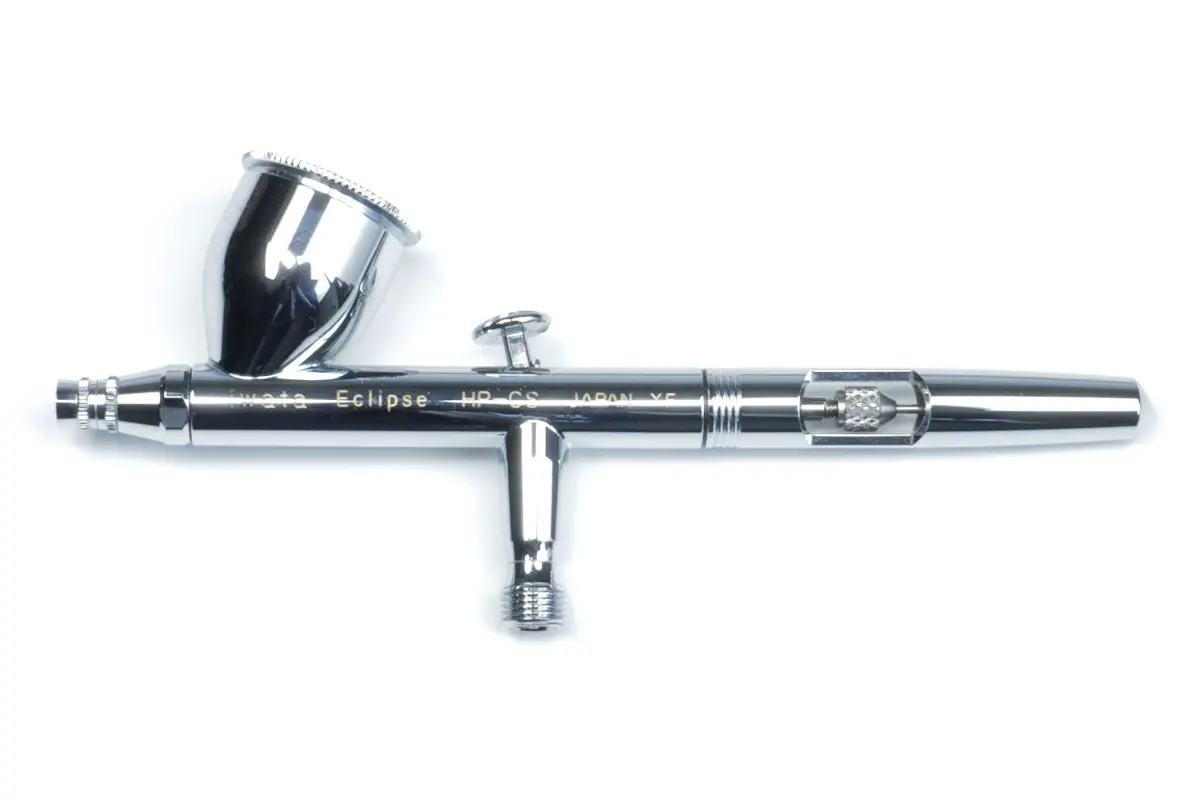
🖌️ 1. Iwata Eclipse HP-CS (Beginner – Pro)
- 0.35mm nozzle
- Smooth dual-action trigger
- Legendary reliability
- Ideal for: Miniatures, T-shirts, general use
Iwata Eclipse HP-CS available on Amazon (See current Pricing)
🖌️ 2. Badger Patriot 105 (Beginner)
- 0.5mm nozzle
- Durable and beginner-friendly
- Wide paint compatibility
- Ideal for: Models, larger coverage tasks
Badger Patriot 105 available on Amazon (See current pricing)
🖌️ 3. Harder & Steenbeck Evolution CR Plus (Beginner – Pro)
- Sleek dual-action design with solid build quality
- Interchangeable nozzle sizes for flexibility
- Trusted German engineering
- Ideal for: Advanced hobbyists and professionals seeking a premium upgrade
Harder & Steenbeck Evolution CR Plus available on Amazon (See current pricing)
🖌️ 4. Iwata Neo CN (Beginner)
- 0.35mm nozzle
- Dual-action with reliable atomization
- Excellent for general-purpose and beginner use
- Ideal for: Beginners, hobbyists, makeup, light detailing
Iwata Neo CN available on Amazon (See current pricing)
💨 Air Pressure Settings for Optimal Performance
Getting the right PSI (pounds per square inch) is essential for smooth operation and avoiding spitting or clogging.
⚙️ Gravity Feed Airbrush Recommended PSI Settings:
| Application | PSI Range |
| Fine detail work | 10–15 PSI |
| General purpose spraying | 15–25 PSI |
| Thicker paints (e.g. metallics) | 25–30 PSI |
Pro Tip: Always test on a scrap surface before committing to your final piece to really dial in your air pressure.
🛑 Common Issues with Gravity Feed Airbrushes
Gravity feed airbrushes are relatively simple, but still prone to a few recurring problems:
❌ 1. Tip Dry
Paint builds up on the needle tip, especially with acrylics. Causes sputtering or inconsistent spray.
❌ 2. Clogged Nozzle
Small or dried paint particles block the nozzle—especially if paint isn’t thinned correctly.
❌ 3. Cup Overflow
Filling the cup too high can cause leaks or bubbling.
❌ 4. Inconsistent Paint Flow
Can be caused by poor thinning, dirty internals, or too low PSI.
❓FAQs About Gravity Feed Airbrushes
Q: Can I use thicker paints in a gravity feed airbrush?
A: Yes, but you’ll need to thin them properly and possibly use a larger nozzle size (0.5mm+).
Q: Are gravity feed airbrushes only for professionals?
A: Not at all—many beginners start with gravity feed because of their precision and ease of cleaning.
Q: Can I spray clear coats with a gravity feed?
A: Yes. Just use the right nozzle size and increase PSI to handle the viscosity.
Q: How often should I clean a gravity feed airbrush?
A: Ideally after every use or color change. Quick rinses between sessions and a deep clean weekly keeps performance consistent.
🧠 Final Thoughts: Is a Gravity Feed Airbrush Right for You?
If your work involves fine detail, tight control, and efficient paint use, a gravity feed airbrush is likely the perfect choice.
From painting intricate miniatures to delivering ultra-fine gradients in body art or cake design, the gravity feed airbrush is a tool that grows with you—whether you’re a curious beginner or a seasoned airbrush veteran.
Still unsure? Try one out. The versatility and control just might surprise you.