Switching colors mid-project shouldn’t wreck your workflow—or your paint job. But if you’re skipping the quick clean, you’re risking clogs, color contamination, and frustrating spray issues that kill momentum fast.
A proper quick clean between colors takes less than two minutes and can make the difference between flawless results and a muddy mess. Whether you’re using a gravity feed, siphon feed, or side feed airbrush, this guide walks you through the exact tools, techniques, and smart shortcuts to flush your system fast—without tearing it down.
If you’ve ever wondered how the pros keep their colors crisp and their airbrushes flowing smoothly all day, this is it.
⏩ Jump Straight to the Quick Clean Steps
🧼 What Is a Quick Clean (When Should You Do It?)
A quick clean, also called a color change flush, is a short mid-session cleaning process that clears leftover paint from your airbrush so you can load the next color without contamination. Unlike a full teardown or deep clean, it doesn’t involve disassembling the brush. Instead, you flush cleaning solution through the airbrush until it sprays clear, sometimes with backflushing or a brief needle wipe.
You should quick clean every time you change colors, especially when switching between very different hues (e.g., red to white). It helps maintain accurate color output, prevents clogs, and keeps your airbrush performing smoothly throughout a painting session.
A quick clean is not just about convenience—it’s essential to maintaining the quality of your paint job. Even tiny amounts of leftover pigment can affect the next color you load, leading to unwanted blending, muddy tones, or inconsistent spray patterns. The more dialed in your quick clean process is, the less you have to worry about paint quality or equipment failure mid-project.
🎯 Why It’s Crucial Between Colors
Leftover paint in the nozzle or cup can mix with your next color, resulting in muddy or off-toned results. Worse, if paint dries internally, it can clog your nozzle or lead to sputtering.
A proper quick clean:
- Prevents color contamination
- Maintains consistent spray patterns
- Saves time vs. a full deep clean later
- Extends the life of your airbrush components
This is especially important when switching between paints with different viscosities or formulations, such as going from a thin transparent layer to a thicker opaque color. In those cases, the residue left behind can alter how your paint behaves and even affect how the paint atomizes. Quick cleaning eliminates those variables and gives you consistent results—regardless of the paint type.
In addition, a routine quick clean helps minimize the risk of more serious mechanical issues down the line, such as stuck needles, deteriorating seals, or caked nozzles—all of which are far more time-consuming and costly to fix than simply flushing out between colors.
🧰 Must-Have Tools, Fluids & Setup Tips
Quick cleaning works best when you’ve got the right tools within arm’s reach. Set up your cleaning station so you can transition seamlessly between colors without scrambling.
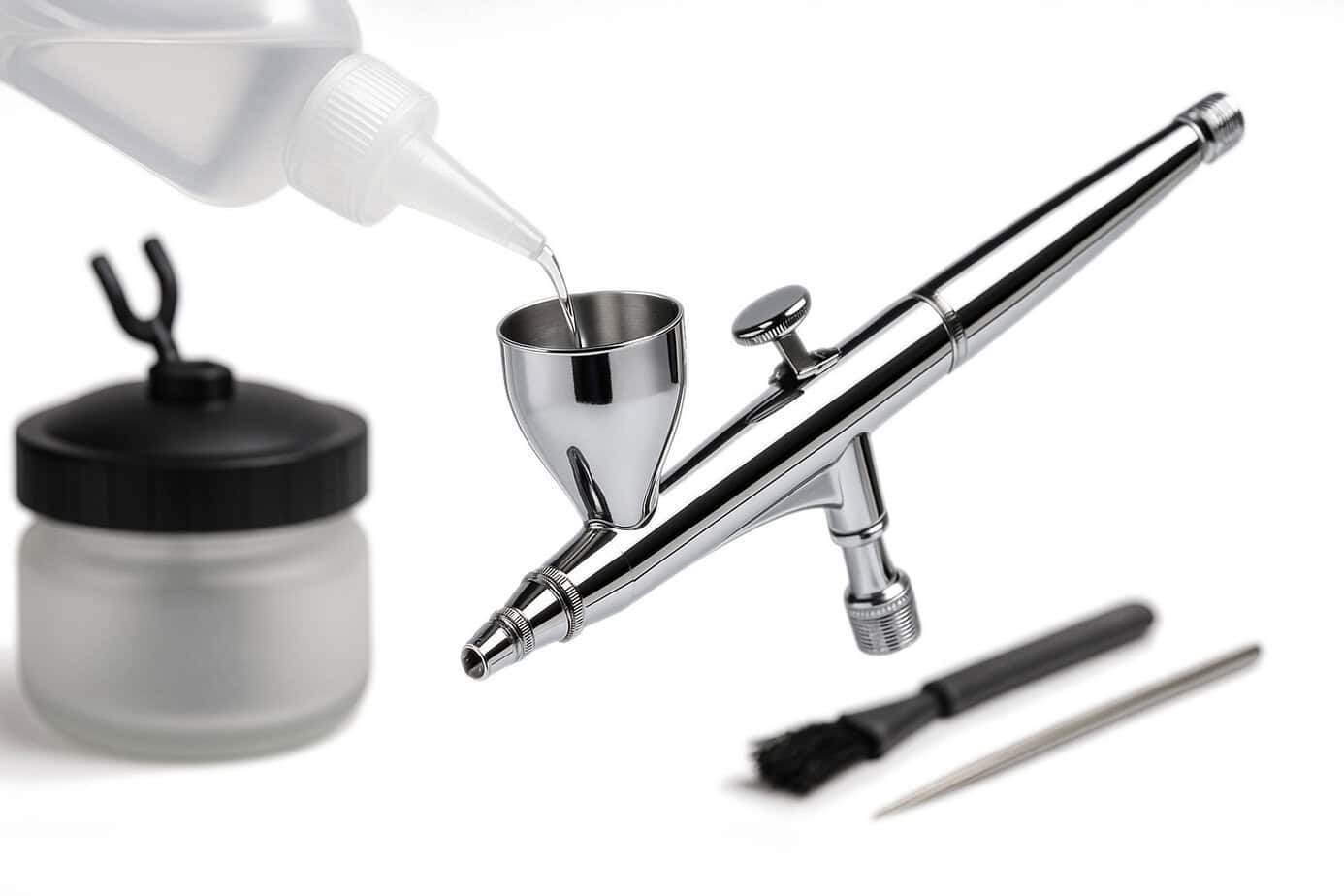
- Cleaning fluid: Use water, airbrush cleaner, or appropriate thinner depending on your paint type (acrylic, enamel, lacquer). Some painters keep separate bottles for each. Avoid using overly harsh solvents unless absolutely necessary.
- Squeeze bottle or pipette: Ideal for controlled rinsing. Lets you direct cleaning fluid exactly where it’s needed without overfilling. This is especially useful for flushing feed tubes and hard-to-reach areas.
- Cleaning pot: Essential for catching overspray and cleaner mist. Look for one with a filter and air vent to contain fumes. If you don’t have a dedicated pot, make sure you use a heavy glass jar or similar container that won’t tip over.
- Soft brush/swab: Useful for scrubbing the color cup and dislodging stuck pigment. Interdental brushes and old paintbrushes trimmed to a short bristle length work particularly well.
- Lint-free cloths/paper towels: Avoids fiber contamination. Blue shop towels and microfiber cloths are great choices. Cut them into smaller squares to reduce waste and improve maneuverability inside the cup.
- Optional gear:
- Spare paint jars (for siphon feed)
- Dedicated bottle with cleaner
- Backflush cap or rubber tip
- Gloves, mask, or respirator (if using solvents)
- Bench mat or drip tray to catch spills
Having these ready eliminates friction and makes color changes feel like part of your rhythm—not a disruption. Creating a dedicated cleaning area or caddy can streamline this even further and encourage good habits over time.
🔄 Step-by-Step: Quick Flush Method (All Feed Types)
Here’s a complete breakdown of the quick clean process you should follow each time you switch colors:
- Dump excess paint
- Gravity feed: Pour out any remaining paint from the color cup.
- Siphon feed: Remove the paint jar and store or discard leftover paint.
- Side feed: Detach the cup if removable or dump carefully.
- Tip: Tilt the airbrush forward slightly as you empty to guide any remaining paint away from the nozzle and back into the cup.
- Rinse the paint cup
- Add a small amount of cleaner or water.
- Swirl with your brush or finger to dislodge paint stuck to the sides.
- For stubborn residue, use a soft brush or cotton-free swab to agitate the cup.
- Spray out the cleaner
- Spray into your cleaning pot or a paper towel.
- Watch for the fluid to shift from colored to mostly clear.
- Use short bursts and vary trigger position to move paint through all parts of the flow path.
- Backflush (optional but highly recommended)
- Cover the nozzle tip gently (finger, rubber plug, or cloth).
- Press down and slightly pull back the trigger to bubble cleaner back into the cup.
- Spray again to clear the dislodged pigment.
- Repeat this 1–2 times depending on how dirty the fluid appears.
- Wipe the cup
- Use a lint-free cloth, brush, or foam swab.
- Clean until the sides of the cup are visually paint-free.
- Take care not to push debris into the nozzle area—wipe outward and away.
- Final rinse and air blast
- Add a bit more clean fluid.
- Spray through, then run dry air for 2–5 seconds.
- This clears any moisture and ensures the brush is dry for the next paint.
- Load the next color
- Test spray onto a scrap sheet or paper towel to confirm no tint or leftover residue.
- Look closely—if the spray looks milky or tinted, repeat the last couple of steps.
When done properly, this whole routine should take less than 2 minutes and drastically reduce the chance of clogs or off-color transitions. Practicing these steps until they become second nature will dramatically improve your consistency and confidence.
⚙️ Feed-Specific Adjustments: Gravity, Siphon & Side Feed
Different airbrush feed systems behave slightly differently during the quick clean process. Understanding how to adjust your method based on feed type ensures a thorough flush without overcomplicating things.
Gravity Feed
- Easiest to clean thanks to the direct top-down paint path.
- Paint flows straight into the nozzle via gravity, which means fewer places for residue to hide.
- A few rinses and a backflush usually remove most of the old color.
- Cup visibility makes it easy to spot leftover pigment.
- Great for detailed work where clean transitions between colors are critical.
Extra tip: Use a soft brush to sweep under the edge of the cup where paint often settles and hides.
Siphon Feed
- Requires more effort due to the longer paint path and external paint jar.
- Paint is pulled up through a tube, which can hold onto pigment residue.
- Disconnect and clean the siphon tube and bottle lid assembly if paint has been sitting too long.
- If you’re doing multiple color changes, it helps to dedicate a second bottle filled with cleaner to swap in quickly.
Extra tip: Use an interdental brush or pipe cleaner to scrub inside the tube if flushing alone isn’t enough.
Side Feed
- Paint enters from a side-mounted cup or jar and feeds horizontally into the brush.
- Not quite as direct as gravity, but easier to manage than siphon.
- Detach and clean the side cup separately when possible.
- Check the feed port closely—this area tends to trap pigment.
Extra tip: Angle your cleaner bottle so the fluid flows into the side feed passage without splashing or overflowing.
Regardless of feed type, regular quick cleans maintain flow efficiency and reduce the risk of buildup that requires a deep clean later.
💨 Backflushing: When & How to Do It Right
Backflushing is an essential part of a thorough quick clean—especially when changing from dark to light colors or after using stubborn paints like metallics. It works by reversing air through the brush to agitate and dislodge pigment stuck in the nozzle and surrounding internal chambers.
When to backflush:
- After spraying high-pigment or thick colors
- When switching to white or yellow
- If the spray pattern becomes uneven during a color change
Steps:
- Add 2–3 drops of cleaner to the cup.
- Cover the nozzle opening with your fingertip or rubber cap.
- Gently press down for air and slightly pull back the trigger.
- You should see bubbles rising into the cup—this indicates pressure is reversing.
- Let it bubble for 5–10 seconds.
- Uncover the tip and spray out the loosened pigment.
- Repeat once more if needed.
Important safety tips:
- Always keep the needle cap on to avoid stabbing your finger.
- Don’t backflush at high pressure—you risk damaging seals or blowing fluid backward into the air valve.
- Hold a towel over the color cup to catch any splatter from bubbling.
When done correctly, backflushing is a safe and effective way to ensure a thorough clean without full disassembly.
🪶 Should You Wipe the Needle Too?
Wiping the needle isn’t required after every single color change, but it’s a useful step when you’re dealing with problematic colors. Paint tends to collect at the tip of the needle and just behind the nozzle—areas where clogs can start forming.
Situations where wiping is smart:
- After spraying thick, sticky, or high-pigment paints (like white, red, or metallics)
- When you notice sputtering or inconsistent spray even after flushing
- If the needle looks visibly coated when you peek inside the cup
Quick wipe method:
- Loosen the chucking nut.
- Carefully pull the needle back about 1–2 inches.
- Wipe the exposed section with a cleaner-soaked, lint-free cloth.
- Push the needle back in until it seats firmly.
- Re-tighten the chuck.
Avoid pulling the needle completely out unless you’re doing a deep clean. Repeated removals can cause wear on internal seals or introduce contaminants into the airbrush body.
A quick needle wipe takes seconds and can solve mystery spray issues that flushing alone doesn’t fix.
🎨 What to Do With White, Metallics & Sticky Paints
Some paints are simply harder to clean than others. These special cases require extra attention during the quick flush process:
White & Yellow Paints
- These are heavily pigmented and prone to clinging inside the cup and nozzle.
- Even after the cleaner runs clear, microscopic residue can remain.
- Always do a second flush and backflush when switching away from these colors.
Metallics & Pearlescents
- Contain reflective flakes that can settle in nooks and crannies.
- Spray test on a scrap surface after cleaning to check for stray shimmer.
- If flakes persist, scrub the cup and nozzle with a brush or swab.
Sticky or Fast-Drying Paints
- Examples: urethane-based, lacquer, some primers, and textile paints.
- Dry almost instantly when exposed to air, leaving behind gummy residue.
- You may need a solvent-based cleaner or longer soak to fully remove buildup.
- Don’t let these paints sit in the brush—even during short breaks.
Whenever you use one of these paint types, extend your quick clean slightly to avoid long-term issues. Two extra minutes now can save you an hour of teardown later.
🧴 Where to Flush Waste Safely (Cleaning Pots & Alternatives)
Proper waste disposal is often overlooked, but it’s critical for safety, cleanliness, and compliance (especially in a professional setting).
Best practice: Cleaning Pot
- Designed to capture overspray and fumes.
- Comes with a replaceable filter and non-slip base.
- Some versions double as airbrush holders.
Decent alternatives:
- Glass or metal jar with a folded paper towel inside
- Coffee can with a foam lid cut to hold the airbrush nozzle
What to avoid:
- Spraying directly into open air—it atomizes cleaner and leftover pigment into your workspace.
- Bathroom or kitchen sinks—paint particles can stain or clog plumbing.
- Trash bins or cardboard boxes—they don’t contain mist or fumes.
If you’re working indoors or around others, use a pot or exhaust system. It’s a small investment that pays off in health and tidiness.
🚫 Avoid These Common Quick-Clean Mistakes
Even experienced artists can get sloppy when in a rush. These common missteps ruin a fast clean and often create bigger problems than they solve:
- Using the wrong cleaner: Acrylic paint doesn’t clean well with water alone. Enamels need thinners. Match the cleaner to your paint type.
- Skipping backflushing: Flushing alone doesn’t always reach behind the nozzle. Skipping this step leads to slow pigment buildup.
- Over-backflushing: Too much pressure or repeated backflushes can cause internal flooding or damage to seals.
- Letting paint sit: Taking a break without cleaning means you’re letting paint dry in place. That always ends badly.
- Using cotton swabs: These leave fibers behind that clog nozzles. Stick with foam or microfiber.
- Neglecting the cleaning pot: Spraying into the air or onto paper towels creates a toxic mess—don’t do it.
The fastest way to clean is to do it right the first time. Build good habits and the process becomes smooth, safe, and automatic.
⏱️ How Often Should You Quick Clean?
There’s no mystery here: you should quick clean every time you change colors. But how thoroughly depends on the paints you’re using, how critical color accuracy is, and how long you’ll be spraying the next color.
Clean more thoroughly when:
- Switching from dark to light colors
- Using paints that cling (white, red, metallic)
- Working on detailed or color-sensitive artwork
- You’ve noticed recent clogging or sputtering
You can be quicker when:
- Staying within a similar color range (light blue to navy)
- Using water-based paints that flush easily
- Doing rough or basecoat work where exact color isn’t critical
Bonus tip: Always quick clean before a break—yes, even 10 minutes. That’s enough time for paint to dry inside and cause problems when you return.
Make it a habit, not a chore, and you’ll save yourself hours of frustration.
🧠 Final Thoughts
Quick cleaning your airbrush isn’t just about speed—it’s about protecting your investment, preserving paint quality, and staying in flow. It’s the unsung ritual that separates consistent results from constant headaches.
Build your workspace around efficiency. Keep your cleaner, towels, and tools ready to go. Whether you’re painting miniatures, textiles, or fine art, a fast, disciplined quick clean process gives you the confidence to change colors without second guessing.
Practice this technique until it becomes second nature—your future self will thank you every time your airbrush fires up smoothly and your colors come out perfect.
❓ FAQs About Fast Airbrush Cleaning
Q: Can I skip quick cleaning for similar colors?
A: Only if they’re extremely close on the color wheel. Otherwise, contamination is likely.
Q: What if I forget to clean and paint dries inside?
A: You’ll need to do a full teardown and soak parts in the appropriate cleaner.
Q: Do I always need to backflush?
A: It’s highly recommended for thoroughness but optional if you’re extremely short on time.
Q: Can I use alcohol or Windex for acrylics?
A: Yes, in moderation. Alcohol is effective but can dry seals; Windex can foam. Use with caution.
Q: How do I know when it’s fully clean?
A: When only clear liquid sprays out, and there’s no color tint or particles visible.